
Sustainability Strategy
The A1 Group actively assumes its ecological and social responsibility by promoting more efficient, resource-friendly, and thus more sustainable ways of working and living. Environmental, Social & Governance (ESG) are seen as long-term value drivers that also entail economic benefits – for instance via reduced energy consumption, lowering both environmental impact and costs.
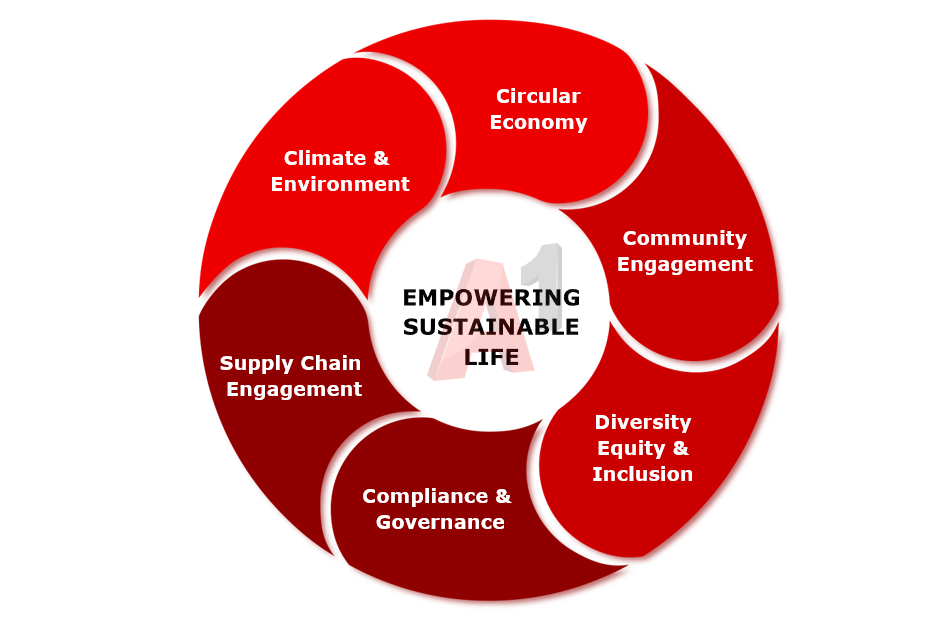
The Group’s sustainability strategy is derived from the current materiality analysis and seeks to leverage the potential of digitalization for the environment, people, and society while minimizing its own ecological footprint. By regular participation in external ratings and indices, the Group faces up to international comparison.
Sustainability management
In 2010, the A1 Group established Group-wide, integrated sustainability management that incorporates the most important aspects of its value chain. Spearheaded by Deputy CEO Thomas Arnoldner, the Group’s top management commits and fully supports sustainability.
The ESG strategy is implemented by the local subsidiaries in the individual countries of the A1 Group. ESG officers in all countries constantly communicate with the individual specialist departments to implement measures and sensitize employees. Events raise awareness among employees and sustainable measures are worked out together.
Established management systems help systematically implement the planned measures. These measures range from certified environmental and energy management systems to a certified compliance management system. Moral conduct as well as lawful and compliant corporate leadership are assured by the compulsory “Code of Conduct”. In its ethical conduct, the A1 Group follows the principles of the UN Global Compact, the world’s most important initiative on CSR (Corporate Social Responsibility) and sustainable development.
Furthermore, the Environmental Policy, which applies to the entire Group, allows A1 Group subsidiaries to implement, control and continuously improve activities concerning environmental and climate protection. With the help of a Clean Energy Strategy, the company is seeking to continuously increase the proportion of electricity generated from renewable energy sources.
Structure
Successful management is characterized by clearly defined roles. The A1 Group has given its ESG activities a clear framework. The principal and patron of the sustainability agendas is the Deputy CEO Thomas Arnoldner.
An ESG team reports directly to the Deputy CEO, who holds the highest level of responsibility on ESG-related decisions. The team manages and coordinates the implementation of the ESG strategy in collaboration with the respective person responsible at the subsidiaries. Its cross-border approach guarantees compliance with the superordinate Group goals. At the same time, this organizational structure creates the required flexibility to take into account regional aspects.
Materiality Analysis & Stakeholders
The A1 Group has conducted a materiality analysis every two to three years since 2012. In 2023, it carried out a double materiality analysis for the first time in accordance with the requirements of the ESRS (European Sustainability Reporting Standards). The results of the double materiality analysis are reviewed annually.
Double Materiality Assessment Process
The double materiality analysis applies to the entire A1 Group, including all subsidiaries, as they share the same business model. The evaluation scales are based on the operational Tech Risk Management and the Enterprise Risk Management frameworks to ensure that sustainability-related risks and opportunities are aligned with other corporate risks and opportunities.
The process comprised three steps:
1. Topic identification and preparation:
Analysis of relevant industry standards (e.g., GRI, SASB) and benchmarking against other ICT and telecommunications companies.
This resulted in a long list of 99 topics along the value chain.
2. Expert Workshops:
Interdisciplinary experts assessed the impacts, risks, and opportunities associated with each topic.
3. Communication and approval:
The results were discussed with Investor Relations and Corporate Communication, presented to and approved by the Management Board, and subsequently presented to the Supervisory Board.
The results are reviewed annually.
Results: Material topics derived from the double Materiality Assessment
A total of 32 topics were identified in 2025 (2024: 35 topics) as material in the course of the assessment.
Environmental (E)
• Climate change (E1): Climate change adaption, climate change mitigation, energy, products (devices), products (infrastructure)
• Resource use & circular economy (E5): Resource inflows, resource outflows
Social (S)
• Own workforce (S1): Secure employment, working time, adequate wages, freedom of association, work-life-balance, health and safety, gender equality and equal pay for work of equal value, training and skills development, diversity, data privacy
• Workers in the value chain (S2): Secure employment, working time, adequate wages, freedom of association, health and safety, gender equality and equal pay for work of equal value, employment and inclusion of persons with disabilities, measures against violence and harassment in the workplace, diversity, child labor, forced labor
• Consumers & end-users (S4 – entity-specific material topic): Information security, (Critical) infrastructure and resilience, digital competences.
Governance (G)
• Governance (G1): Corporate culture, protection of whistleblowers, management of relationships with suppliers including payment practices, corruption and bribery – prevention and detection including training
• Data privacy (entity-specific material topic)
Outlook
The results of the double materiality assessment to identify, assess, and prioritize impacts, risks, and opportunities are reviewed annually to take into account trends, underlying assumptions, context, and regulatory changes. We are gradually working on further quantifying the material risks and opportunities in order to fully integrate them in the A1 Group’s overall risk perspective.
Discover more
ESG Goals
With 12 goals among the three sustainability categories, we aim to minimize our ecological footprint, promote a circular economy, and broaden our initiatives for both employees and society.
Sustainable Development Goals
In order to make a positive contribution to environmental, social and governance issues, A1 Group is committed to achieving the UN’s Sustainable Development Goals.
